Categories
Sculpture

Tambourine

In 2025 I produced a commissioned artwork for a new restaurant called Tambourine on Harrington Street in Cape Town. Tambourine is the latest project by Tobias Alter, owner of the Gorgeous George Hotel, who commissioned our African Robots & SPACECRAFT artwork Shapeshifting Chandelier, installed at the hotel in 2023.

Tobi was interested in our work with dichroic filters, developed during our project SUN for City of Cape Town, with Lorenzo Nassimbeni. Lorenzo and I had worked on the design of SUN over a period of years, and just before it was to be fabricated and installed, the City had to cancel several of their urban upgrade projects due to problems with their contractors, our site amongst them.

A maquette of SUN at about 1:5 scale (final piece was to be 2m diameter)

Dichroic material (architectural glass or a plastic film) reflects and refracts light in such a way that different colours appear from different angles – mainly between magenta and yellow. It has an effect a bit like light reflecting off oily water (you sometime see this in puddles in the street). It was developed for the aerospace industry, as an antiradiation coating on the windscreens of spaceships!

For Tambourine, I designed a system of 20 discs cut from Plexiglass and coated with dichroic film, suspended in adjustable brackets from the reflective metallic ceiling of the restaurant. They’re arranged in such a way that they can be illuminated by just two special narrow-beam spotlights (from Evica Direct). Light from the two spotlights reflects from disc to disc and creates compound pools of light on the upper walls of the restaurant.

Tambourine
A view of one corner of the installation

I think of this as a form of light painting, a fresco in coloured light. Though the lights and discs are static, there’s a feeling of animation about the installation – I think because our minds sense that there is movement in the bouncing of light across the ceiling, though of course much too fast to be perceived. We’ve tried out a bit of vape smoke in there, before the restaurant opened, and it looks pretty cool… we should bring a smoke machine in for a party sometime.

The project for me was really successful in that it met my objective to be interesting yet not distracting, to be beautiful but not impose on the space. The main feature of the restaurant is its food, and socialising with your friends. Feedback from staff and patrons has been very favourable – we really have created something with a unique feel.

Thanks to Amnova for their work fabricating the 3D-printed connectors for the brackets, which we designed together. Lasercutting by Numerical Creations, aluminium tubing from SalBev, bending of stainless steel members by Pure Steel and aluminium anodising by Cape Anodisers. And thanks to Tobi for the commission.
Categories
Writing

Consulting

Do you need help with your writing project? Talk to me: my name is Ralph Borland, and I’m a transdisciplinary knowledge worker with over 15 years experience of higher education and research. I’ve worked across a number of institutions including University of Cape Town, New York University, and Trinity College Dublin.

My first teaching post was with the Expository Writing Program at New York University. I have two publications with MIT Press (see one of them below). I work across disciplines: I wrote my PhD thesis as an artist working in an engineering school, and my most recent fellowship was a collaboration with a surgeon which resulted in a publication in biomedical visualisation (see Bone Flute below).

I’ve supervised Honours and Masters theses. I can help you with your PhD work, and other writing projects. These are my current rates, for online or in person:

1st consultation: 30 minutes, free

R600 per hour thereafter, in a package of 5 hours = R3,000

Hours include reading your work and consultation time (one on one).

Get in touch.

Categories
Writing

Bone Flute

From 2021 – 2023 I was a research fellow in the Future Hospitals project at HUMA – The Institute for Humanities in Africa at University of Cape Town. I contributed to this Pan-African research project investigating the use of new technologies in healthcare in Africa, with my project Bone Flute: a collaboration with an orthopaedic surgeon in a public hospital in Cape Town to produce a flute from a 3D-printed replica of my femur, obtained by medical scan.

A short film from the project made in collaboration with Dara Kell

You can read more about the project, which I presented in my exhibition AIAIA – Aesthetic Interventions in Artificial Intelligence in Africa in fulfilment of my research post, on the project website boneflute.org, where I describe the entwinement of my personal experience as a medical patient during the course of my fellowship, with my research and artwork. The result is a story combining these threads, which you can read on the site.

The website text is drawn in part from a book chapter titled ‘Bone Flute: An Art-Science Research Project‘ (click the title to download a copy) exploring this combination of art-science, research and storytelling which I wrote for the series Biomedical Visualisation, in the 6th edition edited by Leonard Shapiro, published by Springer in September 2024.

Categories
Sculpture

Jetty Square

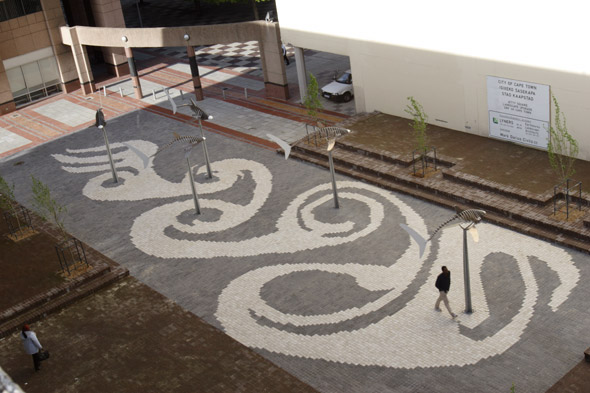
In 2005 Earthworks Landscape Architects (ELA) invited me to work on the design for a new public space in Cape Town’s foreshore – land that was reclaimed from the sea within the last century. I produced a group of ghost shark sculptures, that swim through air 3 metres above the ground, pivoting to point into the wind like weathervanes. They emerge from a cobble pattern of stylised water swirls, designed by Diekie van Nieeuwenhuizen of ELA.

The sculptures make a sound when a strong wind blows, through wind-flutes built into their gills. I worked with the musician Brendon Bussy to design and make the flutes, and on the arrangements of tones across the sculptures. They have infrared sensors in their hollow noses, which move the flutes into position when a person passes below the shark. This layer of interaction is not operational; the square is not yet connected to the City’s electricity supply grid. The flutes are fixed ‘on’ at present, so if you visit the square on a windy day, you’ll hear the sharks sing. Cape Town gets very windy, especially in our springtime.

For more visit www.jettysquare.co.za

Categories
Writing

Design and Futures

In early 2019 studio lead Ralph Borland was asked if he would contribute an article on the theme of ‘Design and Futures’ to a special edition of the Journal of Futures Studies.

I wrote the article while in the thick of working on Dubship I – Black Starliner, a @spacecraft.africa project, in bursts late at night and early in the morning after working on the sculpture, thinking ‘why do I do this to myself?!’ but I was very happy with the result. Thanks to the editors Cher Potter and Stuart Candy for inviting me! I couldn’t resist the opportunity to write about my work in the context of futures studies, a really fascinating field, and there was a pleasing resonance in working at the same time on a sculpture which combines future vision with 800 years of technological history.

Ralph Borland’s Instagram post

The article is titled ‘SPACECRAFT: A Southern Interventionist Art Project’ in Volume 23 no.4 June 2019 of the Journal of Futures Studies. It is freely accessible online at jfsdigital.org ⁣⁣

SPACECRAFT XW01 2019
Categories
Writing

Manual

There is pleasure in writing catalogue essays for artists – at the best of times it becomes a collaboration with the artist and their work, revealing aspects of the work that the artist may not have fully articulated even to themselves, as well as assisting them in communicating the concerns of their art to a public. It requires the work of a detective, conducting a deep reading of and engagement with the art works, and the work of an artist, willing to make word pictures and word sculptures for the reader.

Ralph Borland is proud of the results of this process in his catalogue essay for the sculptor Michele Mathison, for his exhibition Manual at What If The World gallery in Cape Town in 2015. View a pdf of the text here, and see a small extract below.

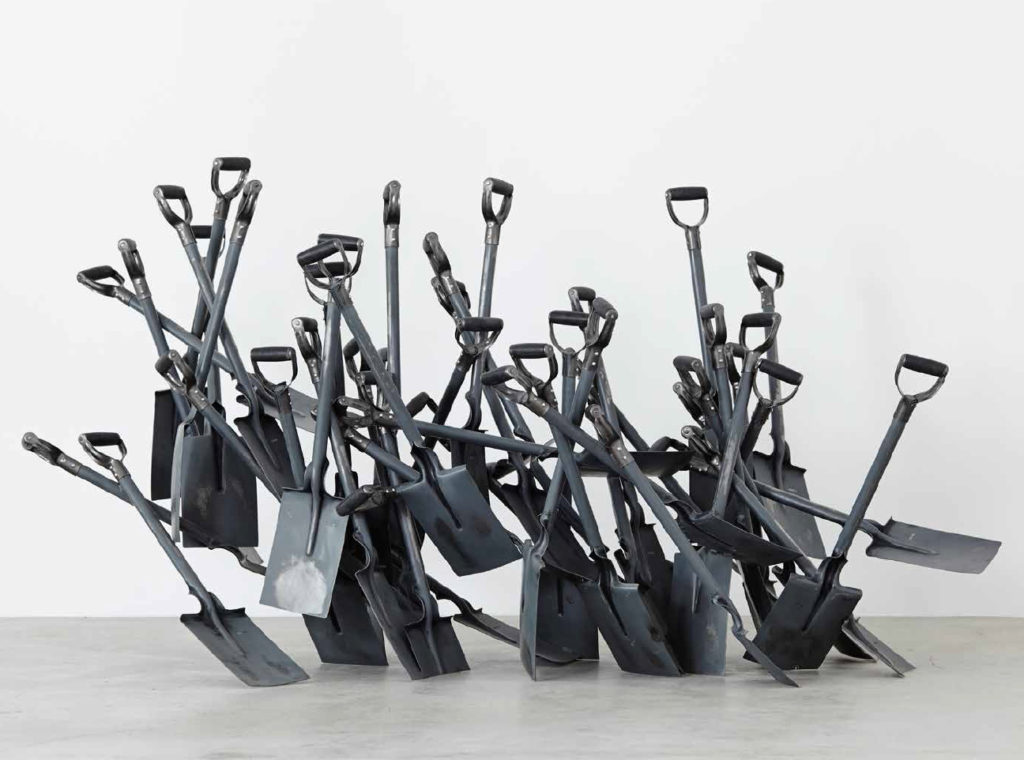
In ‘Dig down’, dozens of bare-metal spades with hard black-rubber handles dig and scrape at the ground, fused together in a multiple-exposure of work – turning now left, now right, forward and back, up and down. They are a condensed expression of a few minutes of labour, made monument – a sculptural expression of a work and motion study. In their hardness and their military tones, worn metal, they hint at the violence of work: this exertion, this digging and scraping, this biting into and relocating of unseen earth.

Manual, Ralph Borland (2015)
Dig down, Michele Mathison 2014
Categories
Curating

Design and Violence

Ralph Borland was one of the lead curators on this 2016 Science Gallery Dublin rendition of an exhibition concept first developed at New York Museum of Modern Art.

Categories
Curating

Future Present

Future Present – Design in a time of urgency is an exhibition in development at Science Gallery Detroit, due to open in September 2020, on which Ralph Borland is one of the curators.

https://opencall.sciencegallery.com/design

Categories
Kruskal Avenue Sculpture

Starling wind mobiles

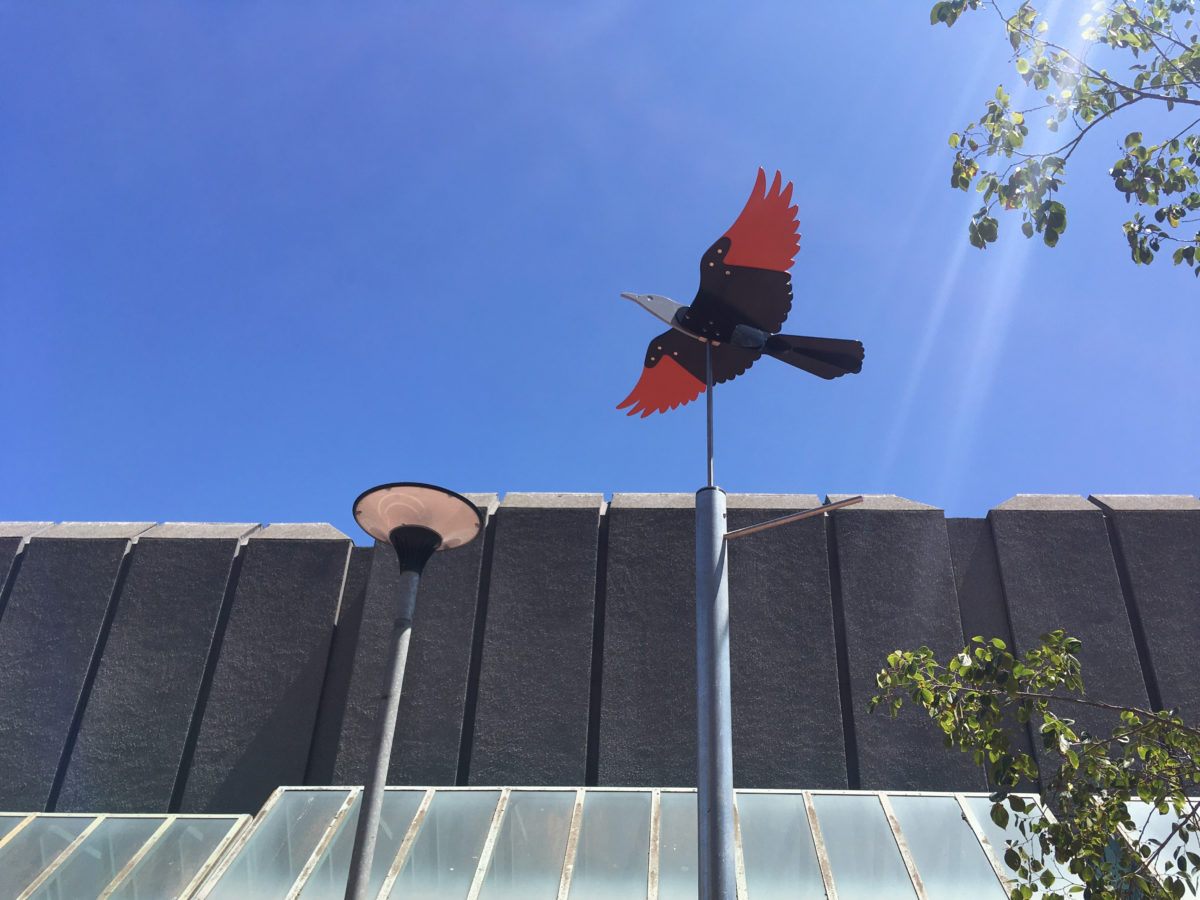
Across the site, sculptures of Red-Winged Starlings rotate in the wind on top of striped poles. These starlings are clever and resourceful birds at home in nature or in the city, and found all down the East Coast of Africa from Somalia to Cape Town. Along with the grasses outside Elizabeth Park, both artworks draw playful attention to small natural elements of the space that might otherwise be overlooked, and reflect to the people who inhabit the site their own resourcefulness and tenacity as they go about their daily lives.

Categories
Kruskal Avenue Sculpture

Giant grasses

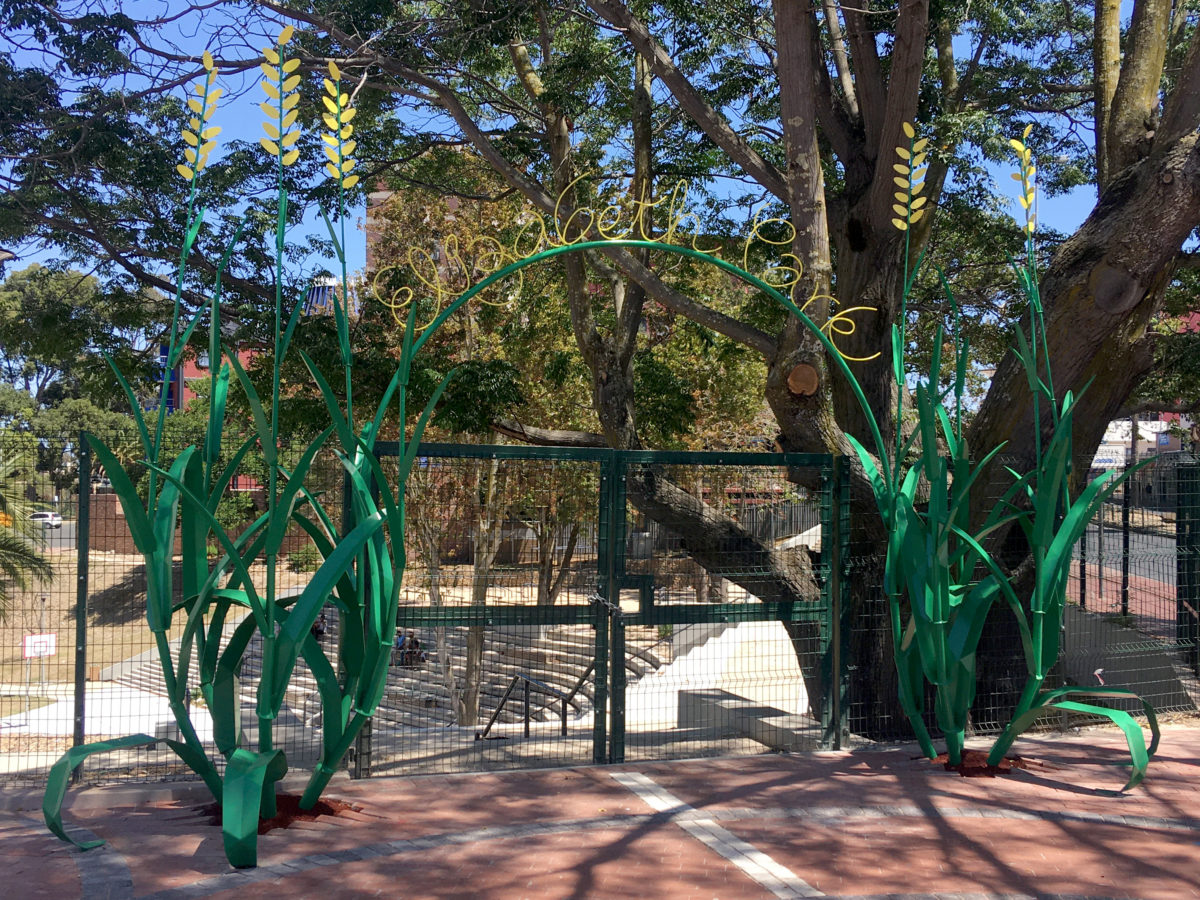
Giant grasses form an entrance to Elizabeth Park: they celebrate the persistence of nature in the city, monumentalizing the tiny grasses that grow up through cracks in the pavement. The work represents tenacity and fruitfulness, and flourishing on little. Along with the starling wind mobiles, both artworks draw playful attention to small natural elements of the space that might otherwise be overlooked, and reflect to the people who inhabit the site their own resourcefulness and tenacity as they go about their daily lives.